If you’ve ever sat across from a parent at an IEP meeting and pointed to i-Ready data to explain where their child is performing — you’re not alone. Most of us have. It’s become the default benchmark tool in districts across the country, practically invisible in its ubiquity.
But here’s the thing: as special education teachers, we are required by law to make decisions based on accurate, meaningful data. Our students’ IEPs depend on it. So when the research starts raising serious questions about whether a tool we’re using every week is actually giving us reliable information — we need to know that.
That’s what this post is about. Not drama. Data.
What the Research Actually Says About i-Ready
Let’s start with the studies Curriculum Associates — the company behind i-Ready — most often points to as proof of effectiveness. Two Johns Hopkins studies on reading and math are featured prominently in their marketing materials. Here’s what’s important to know about those studies: both were conducted in partnership with Curriculum Associates itself, and neither went through peer review. That means no independent experts scrutinized the findings before they were published and promoted.
Dr. Jared Cooney Horvath, a neuroscientist and former teacher who recently testified before the United States Senate on education technology, did an independent deep dive into i-Ready’s full body of evidence. His conclusion: he could find “zero meaningful evidence” that i-Ready is actually effective.
That’s a significant finding for a platform used by an estimated 14 million students nationwide.
And the diagnostic data isn’t holding up to scrutiny either. A 2025 study found that i-Ready’s trimester-based assessments were actually less predictive of future student performance than traditional end-of-year standardized assessments. In other words, the benchmark data it generates may not be telling us as much as we think — or as much as we need it to — when we’re making decisions about our students’ IEPs.
Teachers have been seeing this on the ground for years. Students have figured out they can click through diagnostics quickly by selecting wrong answers. Scores swing inconsistently across assessment windows in ways that don’t reflect actual growth or decline. And the data often doesn’t connect meaningfully to the specific skill-level information SPED teachers need to write and monitor goals.
Why This Matters More for SPED Students
For general education students, an unreliable benchmark is frustrating. For students with IEPs, it’s a much bigger problem.
We use diagnostic data to:
- Establish present levels of performance
- Write measurable annual goals
- Determine baselines for progress monitoring
- Make placement and intervention decisions
If the tool generating that data isn’t valid and reliable — if the scores are inconsistent, not predictive of real outcomes, and not peer-reviewed — then we’re potentially building IEPs on a shaky foundation. That matters in a way that goes beyond frustration. It matters for our kids.
The good news is there are better options. And some of them are free.
What to Use Instead: Tools I Personally Recommend
I want to be upfront here: this section is split into two parts. First, tools I have actually used in my own SPED classroom and can speak to from real experience. Second, tools the research supports that I haven’t used personally but that are worth knowing about.
🏆 Tools I’ve Used and Love
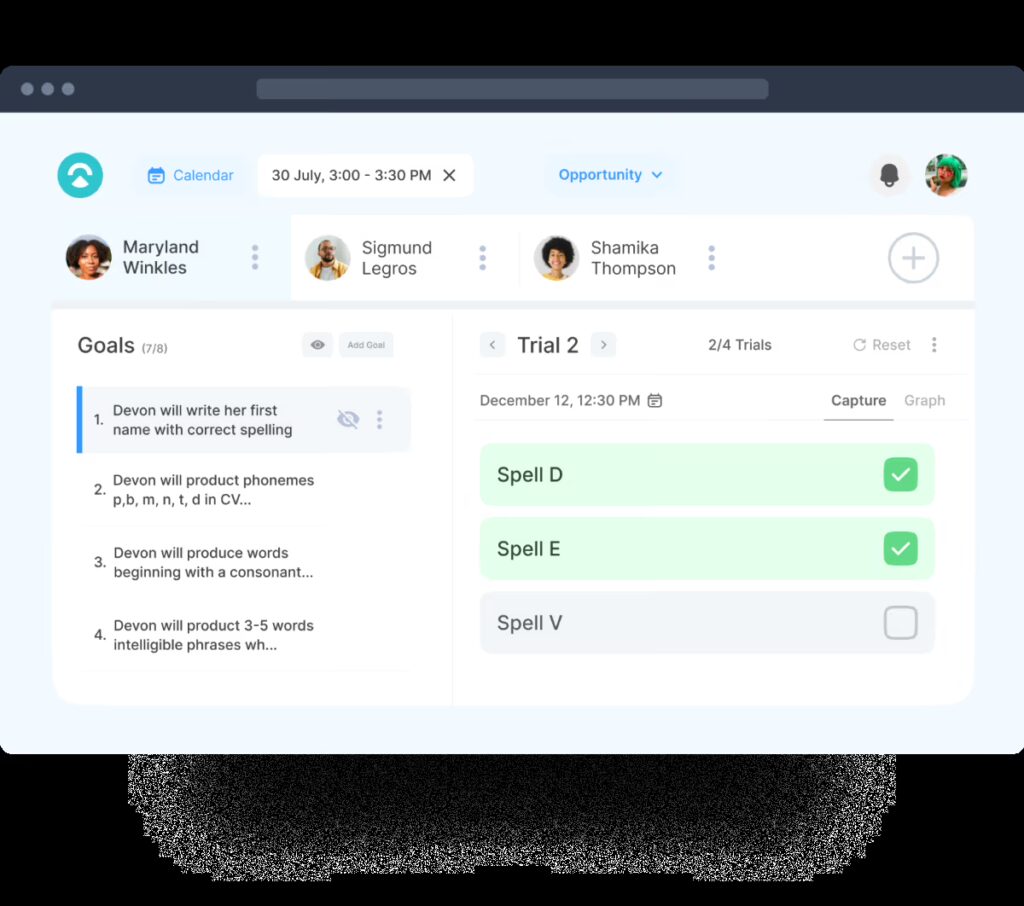
AbleSpace ✅ Free basic version / Paid tiers available I don’t just recommend AbleSpace — I loved it enough to develop a district-wide pilot for it. That’s how much I believe in this tool.
Here’s how I used it in my own classroom: I added my daily schedule directly into the calendar, so every time I opened a group session, I could immediately see all of my students’ active IEP goals for that specific group. I could add data live — in the moment — instead of trying to keep track of things on sticky notes, data sheets, or in my head and hoping I remembered to record it later. For anyone who has ever finished a session and thought “wait, what did I just observe?” — this solves that problem completely.
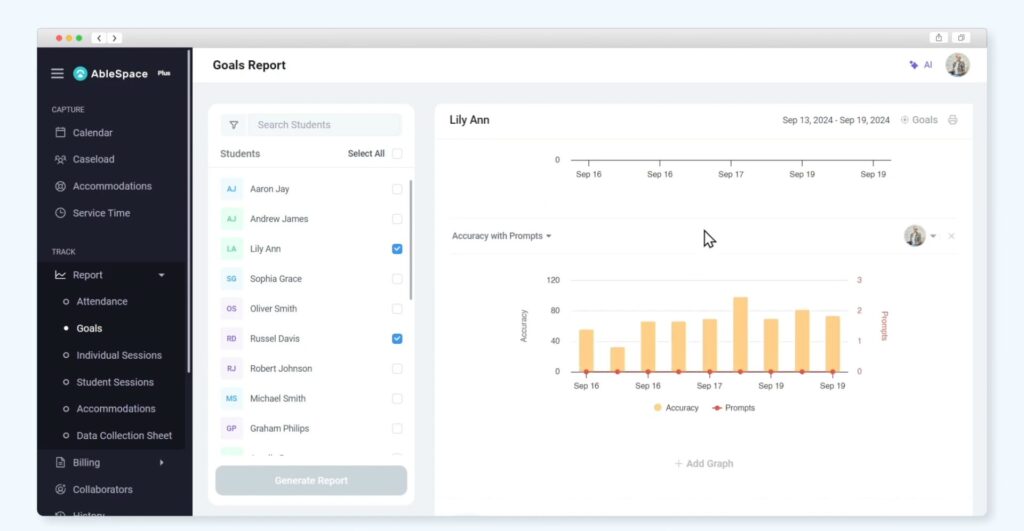
The part that saved me the most time? Progress reports. AbleSpace’s built-in AI summarizes all of your collected data for you automatically. Instead of staring at a spreadsheet trying to figure out what to write, you get a draft summary built from actual data points. I always reviewed and edited — but it cut my progress report writing time down significantly. For a tool that has a genuinely useful free version, it’s one of the highest-value things a SPED teacher can add to their practice. Sign up at ablespace.io.
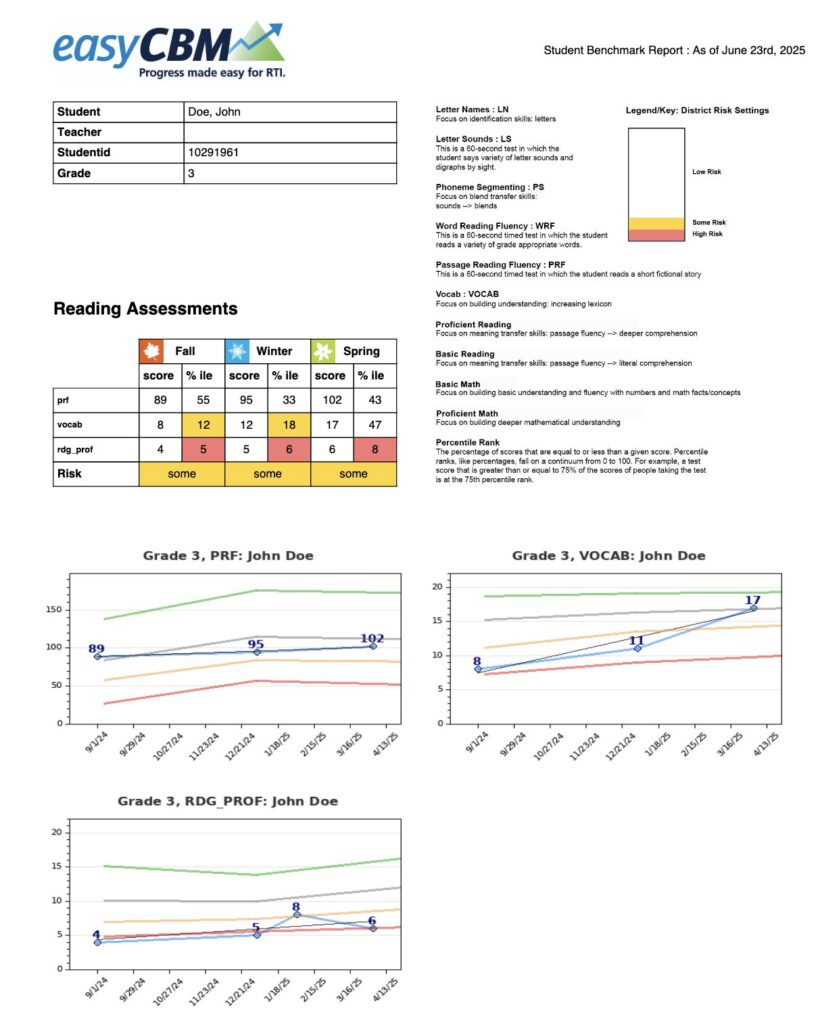
easyCBM ✅ Free Lite version / $39.99/year for Deluxe I’ve used both the free and paid versions of easyCBM and both are solid. It’s incredibly easy to pull progress monitoring probes for reading and math — you can administer them, score them, and keep the data right inside easyCBM, or export and add it to AbleSpace. I’ve done both depending on the year.
My honest take on the math side: the math assessments are useful, but I wish they were broken down by domain — number sense, geometry, fractions, algebraic thinking, etc. The way it’s currently set up, you get a composite score and then have to go back through the assessment yourself and figure out which questions measured which skills. It’s doable, but it adds time. For reading, the probes are clean and easy to use. Sign up at easycbm.com.
📚 Research-Backed Tools Worth Knowing About
These tools have independent, peer-reviewed research behind them and are reviewed by the National Center on Intensive Intervention (NCII) — the gold standard for vetting assessment tools in special education. I haven’t used all of these personally, but they’re worth bringing to your administration if you’re advocating for better assessment tools. The NCII tools chart is publicly available and free — bookmark it.
For reading screening and progress monitoring:
- DIBELS 8th Edition ✅ District — most schools already have this Developed at the University of Oregon with decades of peer-reviewed research. Brief, frequent, and designed for progress monitoring over time with multiple equivalent forms. The go-to for early literacy screening in SPED.
- Acadience Reading 💲 District purchase A direct descendant of DIBELS with updated norms and strong K–6 research support. Worth bringing to the table if your district is looking for a reading benchmark alternative to i-Ready.
- AIMSweb Plus 💲 District purchase Benchmark and progress monitoring for reading, math, and writing. Multiple equivalent forms prevent artificial score inflation — important for valid IEP data over time.
For math screening and progress monitoring:
- easyCBM Math ✅ Free Lite / $39.99 Deluxe (same subscription as reading) Covers math progress monitoring from K–8. As I mentioned above, the domain breakdown requires some manual digging on your end, but the probes themselves are valid and research-backed. Still one of the best free math PM tools available.
- AIMSweb Plus Math 💲 District purchase Includes math computation and math concepts/applications probes with strong research support. A solid option if your district is purchasing a full system.
- Prodigy Math ✅ Free for teachers and schools More of a practice and engagement tool than a formal progress monitor, but it’s free, research-informed, and includes teacher reports that can supplement other data. Useful as one data point among many, especially for math engagement and fluency practice.
For broader academic screening (reading and math):
- MAP Growth (NWEA) 💲 District purchase Strong independent research base with peer-reviewed studies — a meaningful differentiator from i-Ready. Widely used for screening and growth measurement across grades.
- Star Reading/Star Math (Renaissance) 💲 District purchase Computer-adaptive assessments with real-time reporting. Useful for identifying skill gaps and monitoring growth in both reading and math.
For IEP-specific data collection:
- Curriculum-based probes tied to IEP goals ✅ Free Brief, frequent probes built from actual classroom materials that measure exactly what the IEP goal targets. Highly valid, legally defensible, and completely free. Still one of the strongest data sources available to SPED teachers.
- Teacher observation and work samples ✅ Free Don’t underestimate this. Documented observation and collected work samples are among the most valid and legally defensible data sources for IEP progress — and they give you the specific skill-level detail that tools like i-Ready simply don’t.
- Goalbook or Frontline 💲 District platforms If your district has either of these, use them. Both are designed specifically for IEP management and progress monitoring, widely respected for compliance and data tracking.
The Bottom Line
I’m not saying throw out every data point you’ve ever collected on i-Ready. What I am saying is this: it should not be the primary — or only — piece of data driving your IEP decisions. The research simply doesn’t support that level of trust in it.
Pair whatever your district requires with tools that have independent research behind them. Use curriculum-based probes and work samples. Document your observations. And when you need to advocate for a different tool, bring the NCII chart to that meeting.
Our students with IEPs deserve assessment data that is accurate, meaningful, and built on real evidence. That’s not a high bar. It’s the legal and ethical minimum — and they deserve nothing less.
What tools are you using for IEP progress monitoring in your classroom? Drop a comment — I’d love to hear what’s working for you.